★★★★★Google 5.0 · ★★★★★Trustpilot 5.0Super friendly and professional from the very first contact. I have a 4-wavelength diode laser from SIACSKIN and my clients and I are so happy with the results.Nadja Furth · Trustpilot · (translated from German)
Manufacturer from Düsseldorf
2-year manufacturer’s warranty
CE-MDR
Reply within 24 h
✓
Thank you!
Your request has been received. We will get back to you within 24 h via WhatsApp and email.
Combination treatments: how to combine laser, BBL and RF microneedling correctly
Hardly any skin has just one concern: pigment spots come with redness, wrinkles with lax skin, scars with enlarged pores. Combination treatments therefore use several procedures one after the other, each in its own layer. What matters is the right sequence and enough time in between.
This page shows which SIACSKIN devices complement each other: the TULIX or the DERMAFORCE BBL PRO with the RF microneedling of the EUPHEUS, the Nd:YAG lasers PICOLO L and PICOLO S with the FRACO CO2 XL, and further pairings. It also covers intervals, planning as a course of treatment and the limits.
Which laser, light and RF treatments can be combined with one another?
The procedures that can be combined are above all those that act in different skin layers or on different targets. Light treats colour, that is, pigment and redness. Non-ablative and ablative lasers renew the epidermis and the upper dermis. RF microneedling firms the connective tissue at depth. Two procedures with the same target on the same day, by contrast, bring more irritation but no better result. Planning is therefore staggered over time, as a rule with an interval of at least 4 weeks.
At SIACSKIN, this results in typical pairings: the DERMAFORCE BBL PRO for colour, the TULIX for the surface and the EUPHEUS with RF microneedling for depth. This creates a treatment plan that covers colour, surface and depth.
Can you combine thulium laser and RF microneedling?
Yes, thulium laser and RF microneedling complement each other well, because the laser works at the surface and the radiofrequency at depth. The laser improves skin tone, pigment and pores. The RF needles deliver heat into the connective tissue and firm from within. The sequence that has proved its worth runs from the bottom up: first the RF course, usually 3 to 4 sessions at intervals of 4 to 6 weeks, then the laser for the surface. There are at least 4 weeks between two different procedures. On the same day on the same area, the combination offers no advantage.
At SIACSKIN, these are the EUPHEUS with needle depths of up to 7 mm and the TULIX with 1927 nm and 1550 nm. Both involve little downtime, so the plan can easily be spread over several months.
Can you combine BBL and RF microneedling, and in which order?
Yes, BBL and RF microneedling combine well: the light evens out pigment and redness, and the radiofrequency tightens. Because the two act on different targets, they do not interfere with each other. It is usual to start with the course of light treatments, usually 3 to 5 sessions at intervals of 3 to 4 weeks, and to schedule the RF microneedling afterwards with an interval of at least 4 weeks. Light is not used on freshly needled skin that is still red. Sun protection is part of the routine after both treatments.
The DERMAFORCE BBL PRO takes care of the colour of the skin in skin types I to IV, and the EUPHEUS of tightening via RF microneedling. Its Cold Hammer cools the skin after microneedling and, according to SIACSKIN, also after a treatment with the DERMAFORCE BBL PRO.
Can you combine an Nd:YAG laser with the CO2 laser?
Yes, Nd:YAG lasers and CO2 lasers can be combined because they have different jobs: the short-pulsed Nd:YAG laser treats pigment, the CO2 laser texture, scars and wrinkles. This makes sense, for example, for acne scars with dark marks or for sun-damaged skin with age spots and wrinkles. Usually the pigment is treated first and the CO2 laser is used once healing is complete. After an ablative laser, it is more usual to wait 8 weeks before the next procedure follows. With darker skin types, planning is particularly cautious.
At SIACSKIN, the PICOLO L and the PICOLO S are Q-Switch Nd:YAG lasers with 1064 nm and 532 nm that list pigment treatment and carbon peels as applications. The FRACO CO2 XL takes care of skin rejuvenation, scars and wrinkles.
Yes, BBL and thulium laser are an obvious combination for sun-damaged skin: first the colour, then the texture. The course of light treatments reduces brown spots and redness, after which the laser renews the epidermis and refines pores and fine lines. There are at least 4 weeks between the last light session and the laser, so that the skin has settled completely. The combination fits best in autumn and winter, because both procedures require untanned skin and consistent sun protection. For melasma, the light is left out.
The DERMAFORCE BBL PRO is intended for skin types I to IV and treats hyperpigmentation, sun damage and vascular changes. The TULIX then takes care of skin tone and texture with 1927 nm and 1550 nm.
How much time does the skin need between two different laser and light treatments?
As a rule, there are at least 4 weeks between two different procedures on the same area, and more like 8 after an ablative laser. That is how long the epidermis needs to renew itself, while collagen remodelling at depth continues for months. The decisive factor is the condition of the skin: no redness, no flaking, no crusts, no sensitivity. Mild treatments such as a carbon peel can be scheduled with an interval of 2 to 4 weeks. Anyone who plans too tightly risks irritation and pigment spots and gains nothing.
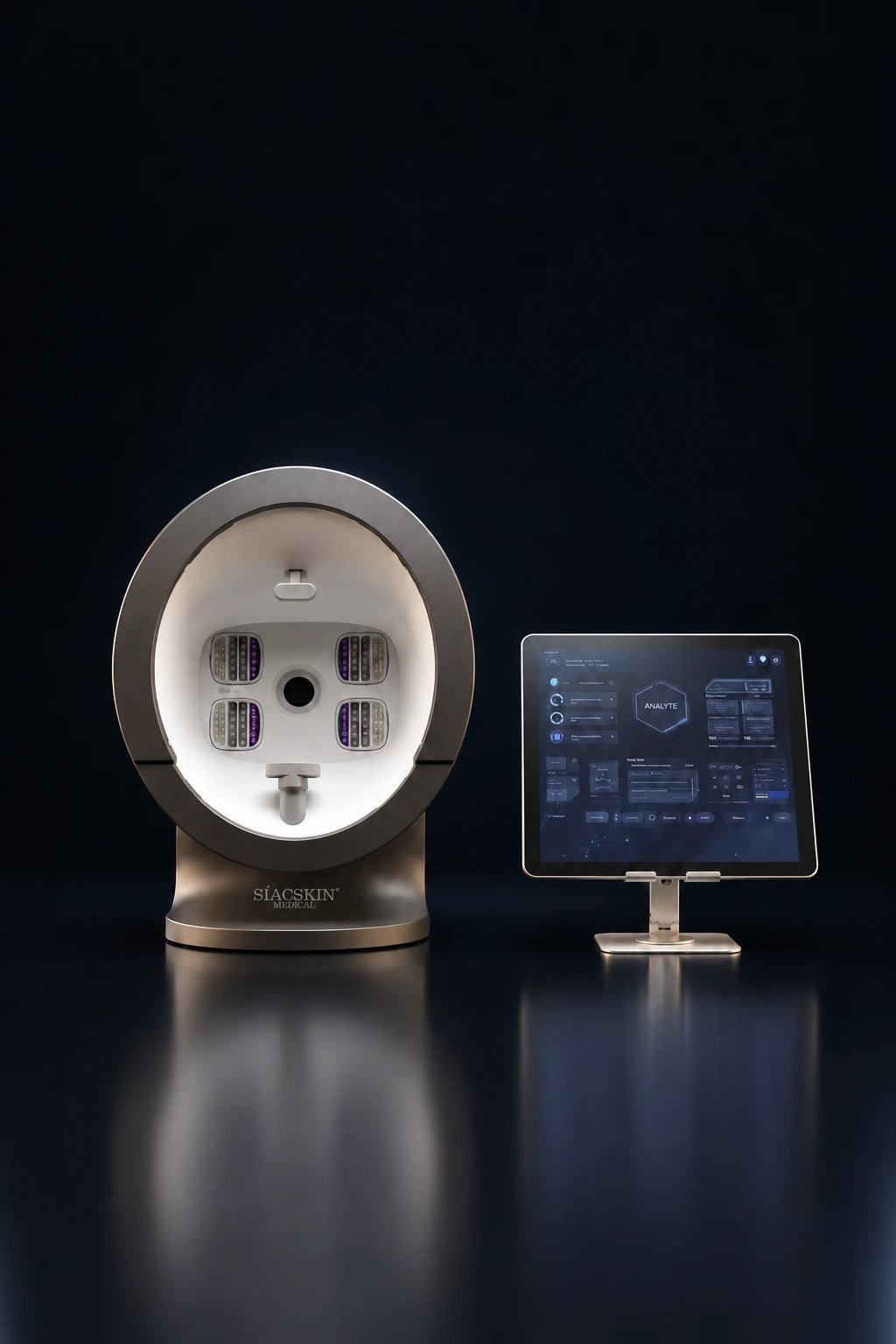
Photos help with the decision. The Skin Analyzer Pro captures the skin under white light, UV light and polarised light and compares before-and-after images before the next treatment starts.
Which treatments can be combined on the same day and which cannot?
As a rule, only treatments that do not irritate each other go together on the same day: different areas, or a mild treatment with soothing skincare and cooling. Two procedures that bring heat into the skin or open the skin barrier are not combined on the same day on the same area, for example laser with RF microneedling, light on freshly needled skin or a peel before the laser. This increases inflammation and the risk of pigment marks without improving the result. Hair removal on the legs and a facial treatment in the same appointment, by contrast, are unproblematic.
The KYROMASTER is suitable for cooling and, according to SIACSKIN, goes with laser, BBL and RF microneedling. With the Cold Hammer, the EUPHEUS has its own cooling for the minutes after microneedling.
In which order do you treat dark spots, redness and wrinkles on the face?
Pigment spots and redness come first, then the wrinkles. Spots and thread veins disturb the overall impression the most and respond the fastest. Once the skin tone is calm, tightening and skin texture follow. On the face, you usually start at depth, because new collagen forms over months, and smooth the surface at the end. On thin skin such as the décolleté, the surface is often treated first and the depth only if needed. There are at least 4 weeks between each of the stages. Before starting, a skin analysis clarifies which concern predominates.
With devices from SIACSKIN, that means: the DERMAFORCE BBL PRO for spots and redness in skin types I to IV, then the EUPHEUS for tightening and the TULIX for the surface.
How do I plan a combination treatment as a course over several months?
Plan the course starting from the goal and spread the procedures over individual stages with fixed appointments. An example for mature, sun-damaged skin: in autumn, 3 light sessions at intervals of 3 to 4 weeks, then 3 sessions of RF microneedling at intervals of 4 to 6 weeks, and to finish, one session with a non-ablative laser. That adds up to a good six months with roughly one appointment a month. Record the starting condition, interim stages and result with photos, and arrange 1 to 2 maintenance appointments a year.
The DERMAFORCE BBL PRO stores client data and treatment area documentation in its integrated client management system, and the TULIX documents treatments via its cloud software. The RF microneedling in between is handled by the EUPHEUS. You can work out how such a package pays off in the price calculator.
Do combination treatments increase the risk of side effects?
Hardly, if planned correctly; yes, if planned too tightly. Every treatment triggers a controlled irritation, to which the skin responds with renewal. If the next treatment meets skin that has not yet settled, the stimuli add up: redness lasts longer, and the risk of dark spots rises, especially in darker skin types and after sun exposure. With sufficient intervals, cautious settings at the first appointment and consistent sun protection, the risk stays within the range of the individual procedures. Medication, tan and skin conditions are checked again before each stage.
The devices provide support here: the DERMAFORCE BBL PRO adjusts itself automatically to skin type, body area and energy parameters via the SIA AI. The EUPHEUS monitors impedance and temperature.
Can laser hair removal be combined with a BBL treatment in the same zone?
Yes, laser hair removal and a BBL treatment can be combined in the same zone, but not at the same appointment. Both procedures warm the skin, and too much heat at once raises the risk of redness and pigment disorders. At least 2 to 4 weeks between them is usual, during which the skin settles completely. This makes sense on the face, for example, when a client has fine hairs on the upper lip and at the same time pigment spots or redness.
The DEWEON 4LD handles hair removal with its four wavelengths. The DERMAFORCE BBL PRO treats spots and redness with its pigment and vascular filters and is designed for skin types I to IV.
Can a picosecond laser and a thulium laser be combined for stubborn pigment spots?
Yes, the combination makes sense for stubborn or mixed pigment spots, because the two lasers work in different ways. The picosecond laser shatters sharply defined spots with a pressure wave, while the thulium laser renews the pigmented epidermis across the whole area in many micro-zones. This lets individual dark spots and an uneven complexion be treated in one plan. There are usually at least 4 weeks between the procedures.
The PICOLO XL works at 280 ps and treats age spots and pigment disorders. The TULIX adds 1927 nm for hyperpigmentation and sun-damaged skin. Melasma calls for particular caution, and very mild settings are used there.
Can skin changes after tattoo removal be treated with a laser or RF microneedling?
Yes, if an altered skin texture or a slight imprint of the design remains after tattoo removal, a fractional laser or RF microneedling can often improve it. Both stimulate new collagen and blend the surface with the surrounding skin. Treatment only begins once the skin has healed completely, usually 6 to 8 weeks after the last laser session at the earliest. Light patches from pigment loss, however, respond only a little to these procedures.
At 1550 nm the TULIX improves scars and skin texture without removing the surface. The EUPHEUS delivers radiofrequency through real gold needles precisely at depth. A treatment plan determines which procedure comes first.